Starting this year I will be offering Private Coaching weekends at my training field in Ontario, OR this year. These weekends will be limited to 6 handler/dog teams and will be very personal and focused on the needs of each team. Topics will vary and be dependent on what each team needs
Because the summer months can get pretty warm here, this will not be a “traditional” 9-4 seminar. We will work for a few hours in the morning, break through the afternoon and work again for a few hours in the evening. My intention is that these weekends will be very low-key and flexible, there won’t be traditional lectures, and drills set up. We will set up exercises for what each person needs, with low-key lectures and discussions throughout each session. More of a training get together with friends, than a structured seminar.
So there can be varying levels of dogs within the group, different focuses, different goals etc. Each weekend will need to have a minimum of 3 working teams, and max of 6. So this would be a great opportunity to get a group of friends together! Jimmy can probably also be convinced to smoke a brisket one of the evenings as well.
I have the dates listed below as just Saturday and Sunday, but if the group wanted to add Friday, that can be done also.
Cost for each working team is $100 per day
Priority for these weekends is given to members of the Fluid Motion Coaching Group.
Private Coaching Dates
June 29-30 (Filled)
July 6-7
July 13-14
Aug 3-4
Aug 10-11
Aug 17-18 (Filled)
Email me to secure a weekend! Fluidmotionagility@gmail.com
Every new year social media is filled with posts about setting goals for the new year, creating new habits, or letting go of old ones.
And every year I usually do something along those lines, buy new planners and tell myself this is the year I will finally use them. I plan a new habit, commit to eating healthier, exercising more, etc.
And almost every year I fail at them.
I have a pretty healthy dose of ADHD paired with some other fun things, and having only been diagnosed for two years I have never taken my ADHD into account when planning for my new year. (there will be some longer blogs and videos on ADHD and agility coming soon)
I saw a post back in December about setting New Year’s resolutions with ADHD and instead of setting a goal or resolution that can set us up for failure if it is not met, set up acceptance goals.
The examples of acceptance goals used in the post were things like:
“I’m going to ask for help when I am struggling”
“I am going to say no when I am feeling burnt out”
” I am going to put my mental health first”
I am aiming to work on acceptance goals for this year instead of new years resolutions that can look like this:
“I am going to lose 10 pounds”
“I am going to train my dog every day”
“I am not drinking soda”
I think acceptance goals for agility/dog training can work as well, and could look something like this:
“I am going to accept my dog for who they are”
“I am going to put my dog’s mental health/confidence first”
“I am going to write down one positive thing from every run at a trial”
Another thing that was talked about was instead of having a resolution or goal for the new year, focus on a word, and make that your focus for the new year. So it is not a “goal” in a sense, but when you are struggling, or looking for focus, you can think about your word for the year.
Your word can be something like
“Confidence”
“Progress”
“Joy”
or in one of the comments someone chose the word “Water” because water can change and flow, it also has the strength to move rocks, or over time can change the shape of a mountain.
So for the new year, I am choosing a word as my focus, and working on acceptance goals, both for my personal life and agility.
Want to discuss this further? I will be talking more in-depth on this subject on the open board in the Fluid Motion Community
If your dog is struggling to continue driving after you have cued a turn away, or in my case a “Switch”, here are some tips!
If my dog is struggling with continuing to drive to the next piece of equipment after a Switch (or any turn) I want to first break down that skill by asking myself some questions about the skill itself.
Does my dog fully understand what a Switch cue is?
Have I worked on my Switch from all handling positions and with each piece of equipment?
Have I proofed my dogs understanding and confidence with a Switch by adding distance?
Most of the time when I see dogs who are having difficulties pushing forward after a Switch, they do not fully understand all of the fundamentals of the skill itself. I like to break the skill back down to a foundation level and work with the dog from there.
I also want to make sure that the dogs rate of reinforcement is very high, and not move forward to more difficult exercises even though I may be working with an Elite level dog who “can” work those harder sequences.
If I am looking to create more drive after my Switch, I am going to start back at my foundations of how i taught the exercise, and before I move to a harder set up, I will go through these steps.
Set up foundation exercise for teaching the Switch Cue
High rate of reinforcement for the dog performing this base exercise. I am not looking for speed, or accuracy or the turn here, I am building confidence and understanding of the base skill.
When I have reached my goal for the base skill (this goal will vary with the dog, but as an example, the goal I had for Wall-E when I did this was him performing the Switch with no head checks, and my handling distance at 10 feet)
Now I will increase the difficulty by creating a goal for more precision with the skill. Depending on the dog, this could be asking for a tighter path, or increase in speed.
I will start again at my base skill (so if i added distance, like I did with Wall-E, i will move back to being closer to him while I increase precision)
When I am increasing their precision either for a cleaner turn, or more speed, I will still be rewarding every Switch they do, but I will be giving a higher reward for the Switches that meet my goal. For example, I may reward with a toy for every Switch, but for a Switch that meets my goal I will reward with the toy along with lots of engagement/play and possibly food jackpots as well.
I will continue through these steps as I increase the difficulty of the exercise and continue to add layers of precision to the skill.
In the Fluid Motion Community over the last couple of months I have been doing what I call Car Chats.
Topics have varied from negative self talk, prepping for NADAC Champs, to what age to start training.
Below are some clips from a car chat where I discussed confidence and distance training in agility. The full lecture can be found in the Fluid Motion Community!
Throughout all my years with dogs I am pretty sure I have fed everything under the sun. Budget kibble, high end kibble, commercial raw, dehydrated, DIY cooked, and raw, grain, grain free, and combinations of all the above.
I compete in agility with all my dogs, and over the years I have found that for them, including some type of grain helps with their physical and mental performance, so I tend to always include that with whatever variation I am feeding.
My choice in what type of food I feed has generally depended on how my dogs do on it, and the price. Those have always been my driving factors when choosing food. The past few years I have been very driven towards feeding as close to “fresh” or “raw” as I can. Mostly pushed by others on social media. So I have been feeding dehydrated and freeze dried foods, primarily Grandma Lucys and Honest Kitchen base mix and then adding my own protein. When I travel I moved toward their complete foods so I am not packing raw meat with me.
And this has been well and good, my dogs have been looking good on this, and performing well.
But over this past year, another factor that has now come into play is my own mental health. And this has now become a pretty big factor in choosing my style of dog food (commercial, DIY, etc)
When I found myself one day dreading making up my dogs food, or needing to go buy more meat, I knew I needed to change something.
I am still feeding a rotation of food, primarily a complete food and when I feel like it, I will make some DIY for a base mix, or one of my balanced recipes. But I do not force myself any more, and I let myself be okay with giving them kibble one night. I buy what works for me financially that month, and what works for me mentally. If finances are good, but I know I am busy and having a rough month or week, I am buying something easy. If I am feeling good and I want to meal prep, or do a base mix and money allows, I will do it.
I feel something that is not talked about when it comes to feeding dogs and everything that it entails, is our own mental health. There is NOTHING wrong with feeding kibble because that is what you can do, even if you “have” the money for raw or whatever the current “best thing to feed your dog is” but you don’t have the mental space for it. I think that is something that needs to be taken into consideration.
Because giving your dog the “best” but you are slowly suffering because of it, is not doing your dog any favors, or yourself.
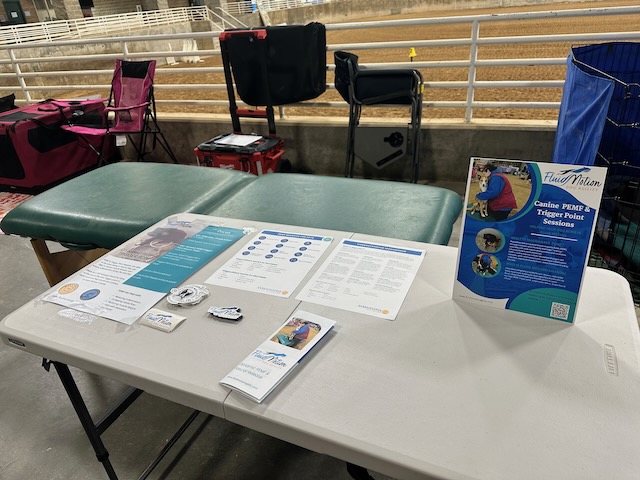
Last weekend I packed up the car and headed to South Jordan, UT for the Bad Ass Agility UKI Festival. This was my first time offering Trigger Point and Dynamic PEMF at a UKI event like this and it did not disappoint!
It was a large facility that I was familiar with from holding NADAC Championships there many years back, and I was able to have my table where I could watch most of the trial over the weekend.
There were some amazing dog and handler teams entered and I loved being able to see so many of these runs in person, and watch all of the different handling styles.
When I wasn’t watching the trial I worked on multiple dogs for all three days and met some really wonderful people! I incorporated my Dynamic PEMF work with almost all of the dogs I worked on as well as lots of fascial release work.
This event is definitely on my list for next year! I made a quick video showing some of the events over the weekend!
I am always on the lookout for new style bowls, enrichment mats, or puzzle style feeders. After publishing a video on why I am not a fan of most all of the hard plastic slow feeders, The Puzzle Feeder reached out to me to ask if they could send me one of their bowls to test out and give some feedback on.
Before I agreed I wanted to check out what their bowls were all about and more about the company. This was back in November 2022 and they got started through KickStarter. I went through their website, and learned more about the bowls, how they are made, and the values of the company.
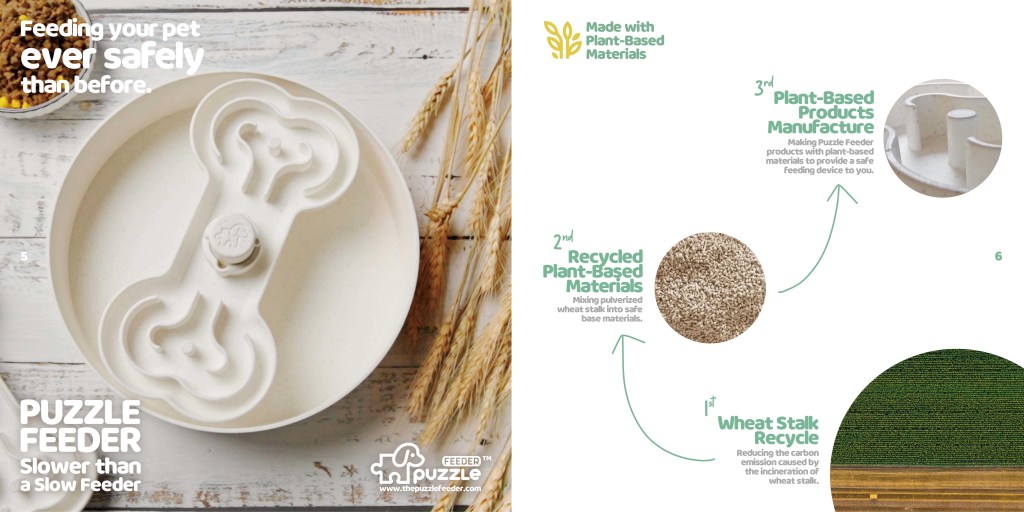
Their bowls are made from compressed wheat stalk and with no toxic materials. This was a very big win for me as I really wanted to find a feeder that wasn’t made from plastic, and didn’t run the risk of having toxic materials. I had been using the Pet Platter for many years, a big selling point for the platter it is made from non-toxic materials
What the bowl is made from
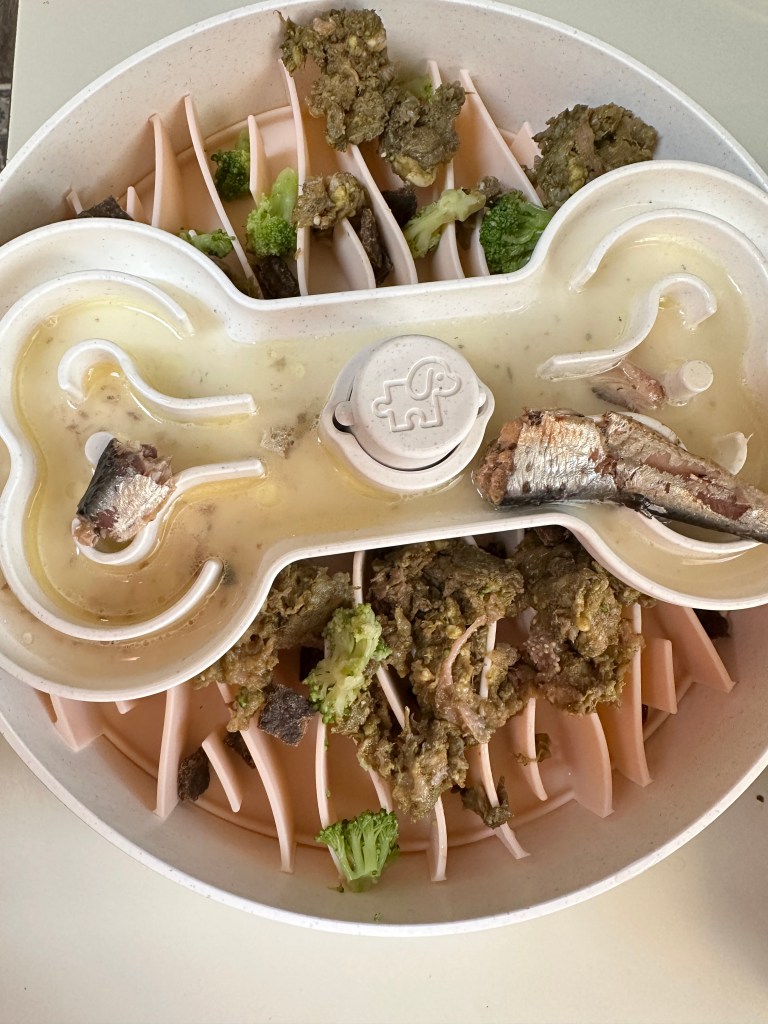
The bowl itself is pretty big and could easily hold all of my dogs food, whether that was my Grandma Lucys, raw, or kibble. The bowl also features a spinning “bone” attachment to add another layer of difficulty. I wasn’t sure when I first got the bowl if the bone was really necessary, or if i would like it. But i have been using these bowls for months now and the spinning bone has become my favorite part!
Measurements – Its just under 10” in diameter and 3” tall. With a capacity of 8 cups of food.
As of right now you can purchase either the Slow Feeder bowl or the Lick Mat bowl. And these inserts are interchangeable and later this year you will be able to purchase just the insert, so you can change what insert you want with a single bowl.
Slow Feeder Insert
I was prepared to not like the Slow Feeder insert as I am very picky about slow feeders.
They are usually made from a hard plastic, and I have used many different brands with the same result, they push up on the dogs nose. While this may not seem like a big deal, the nose is very sensitive with many nerve endings, and watching dogs having to push their noses into the slow feeder makes me cringe.
I have also seem a lot of frustration from dogs using a hard slow feeder, or even ones with a lot of small hard to get to spaces. I am pretty sure I have used every slow feeder on the market, and they all seem to have the same result.
Ally using the Outward Hound slow feeder
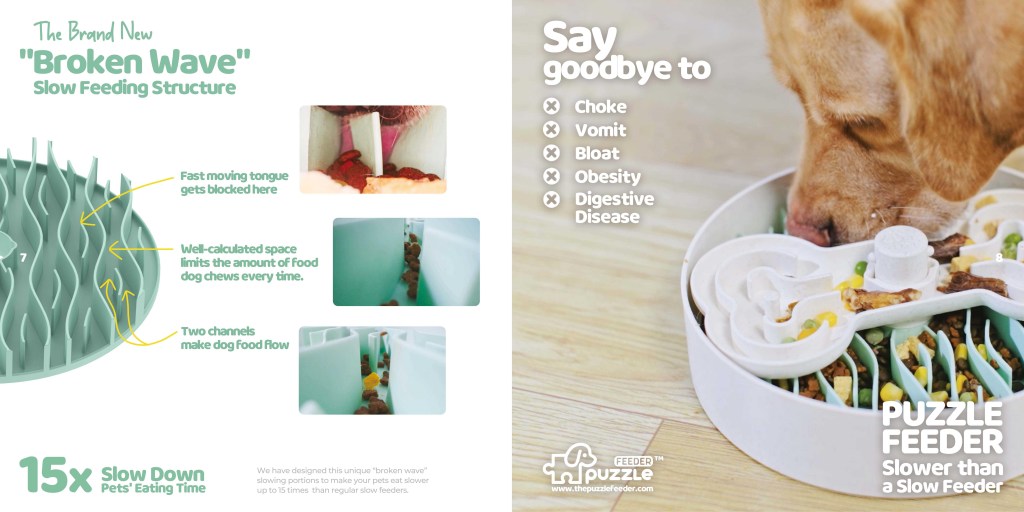
When I first opened the Slow Feeder insert I was immediately happy with how soft the silicone is, as well as the “wave” pattern. This offered enough difficulty to help my dogs slow their eating, but not to the point to cause frustration, or pushing their nose into the small crevices.
Ally becomes very frustrated with slow feeders and tends to either lose interest in eating, or jam her nose harder to try and get everything out. I wasn’t sure how much the Wave pattern would really help this, and i think that it a huge help in frustration levels, not pushing on their sensitive nose, while still slowing their eating time.
Ally using the slow feeder insert
Lick Mat Insert
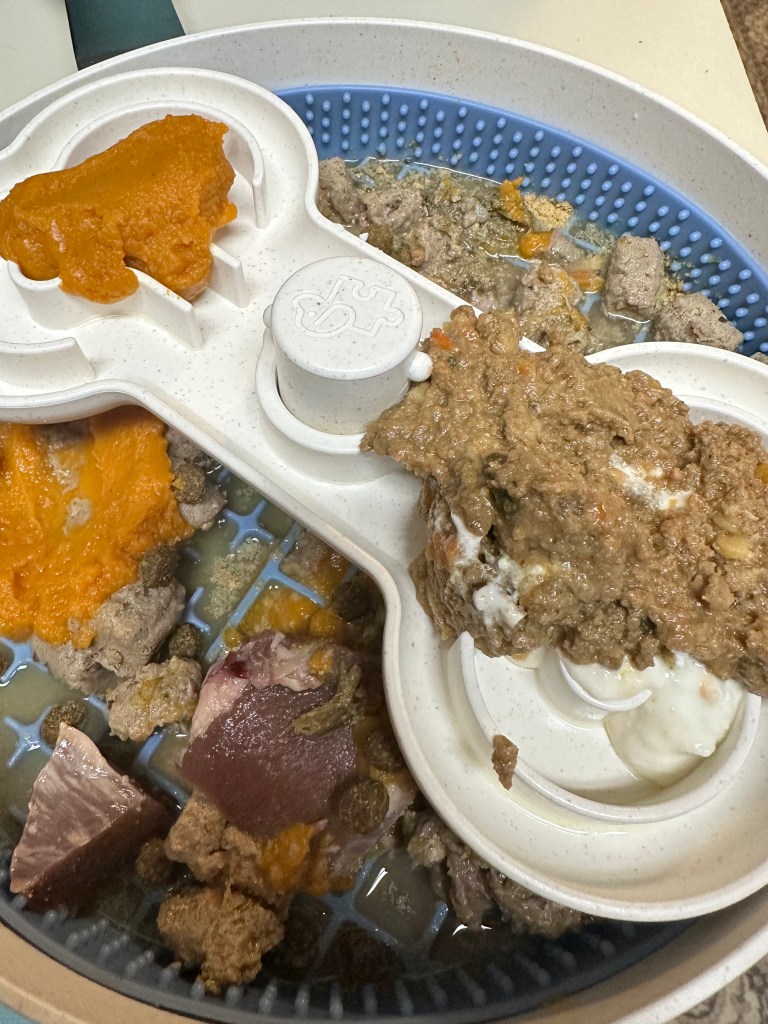
I really loved the Lick Mat insert, it has different patterns within the mat for different textures for the dog, as well as using different kinds of food.
Both of the inserts can be removed from the bowl and washed. (All pieces of the bowl are dishwasher safe) I will say that the Lick Mat insert was a little hard to get out the first few times, but I figured out how to grab the middle and pull it out of the bowl.
Two different ways to pull out Lick Mat Insert
How I use the bowls
What excited me the most when looking through the Puzzle Feeder website was all the different ways I could use these bowls.
I could use either the LickMat insert or the Slow Feeder insert to adjust the level of difficulty, or vary the style of enrichment style feeding, as well as use the inserts without the spinning bone to lesson difficulty. I could also put food in the Lick Mat insert and then freeze just the insert for a longer lasting enrichment session.
I love this bowl for my old girl! I use just the bowl (no insert) and the spinning bone. She has some pretty severe cognitive issues and sometimes things like Toppls, or even Lick Mats are hard for her and she loses interest in eating, which is not a good thing at this age.
So for her, using just the bowl with the spinner provides some enrichment, without being too hard. And I want to use things like this with her that provides enrichment, and works her mind so she doesn’t decline even faster.
Nargles using the bowl with spinner
Final Thoughts
Overall I like these bowls, I was sent the first two (one with the slow feeder and one with the lick mat) but I then went and purchased another two bowls so all my dogs had one.
I use them almost daily with all my dogs (another post coming soon on why i switch up how my dogs eat ) and I can switch how I use them for each dogs and their needs, or to give them variety in the bowls for enrichment and difficulty.
The bowls have held up well with no wear in either the bowl itself or the inserts.
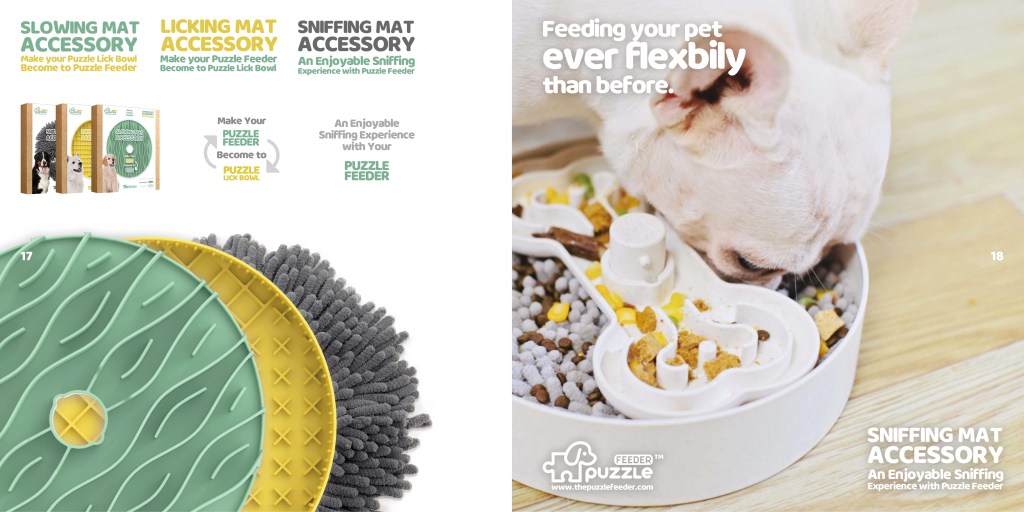
I am looking forward to their new product this spring, a Sniff Mat insert! The pictures on the website of the Snuffle Mat insert look very cool and I am excited that I can add that to my bowls to once again add some variety in how I feed my dogs, all with one feeder.
Sniffing insert come 2023
You can use this code: lovepet01 for 10% off your order
Note: I do receive a commission for those that use the above code, this helps me continue to review products and post blogs focusing on agility coaching, training, health, and fitness! Thank you!
Winter has officially started at my house here in Eastern Oregon, which means outside training time for my dogs has greatly decreased.
While we still go outside for play time and daily exercise, with the off and on rain/snow, any agility training is off the table until spring.
For my dogs I enjoy having some forced time off during the winter. Not only do I feel that it is beneficial for my dogs mental health, I also strongly feel that having some time off is crucial for my dogs physical health as well.
Generally my trialing season slows down quite a bit after NADAC Championships in Sept/Oct. I will generally attend 2-3 trials in Oct and November, but from then until about March, my dogs have that time off.
Their time off consists of no agility training as far as obstacles, and no trials. But this doesn’t mean that they sit around the house for months on end doing nothing.
They still get daily exercise and play time outside, along with enrichment puzzles/toys 2-3 times a week. (more on why my dogs don’t eat all their meals from enrichment toys in a future blog)
During the winter I like to teach my dogs at least two new tricks, as well as work on strengthening their foundational skills. Teaching new tricks helps continue to build a working relationship between myself and my dog, as well as help with my dogs cognitive health by learning something new.
I strengthen their foundational skills like directionals, contacts, startlines, etc, by going back to the foundation steps of how I taught those skills. By taking your dog back to these foundation steps each year, no matter if they are young and in Novice, or in Elite, will help continue to strengthen and make those advanced skills even more solid.
The benefits both mental and physical of having time off from trialing, and obstacle work, to working on those foundational skills is huge, and has a big pay off for both you and you dog!
What are your plans this winter with your dog? Let me know in the comments below!
Wanna see what I am doing with my dogs this winter? Come join the Fluid Motion Coaching Group and join me in working foundations this winter!
In the first lesson of this Directional Series I will be talking about the foundations for how I teach my Out cue.
Out for my dogs means for them to move away from me, or take the obstacle furthest from me.
I like to begin with teaching an Out using cones, but you can start with a hoop as well.
First, like all your cues, you need to define what an Out cue means to you. As well as what your body language and verbal cue look like for your cue.
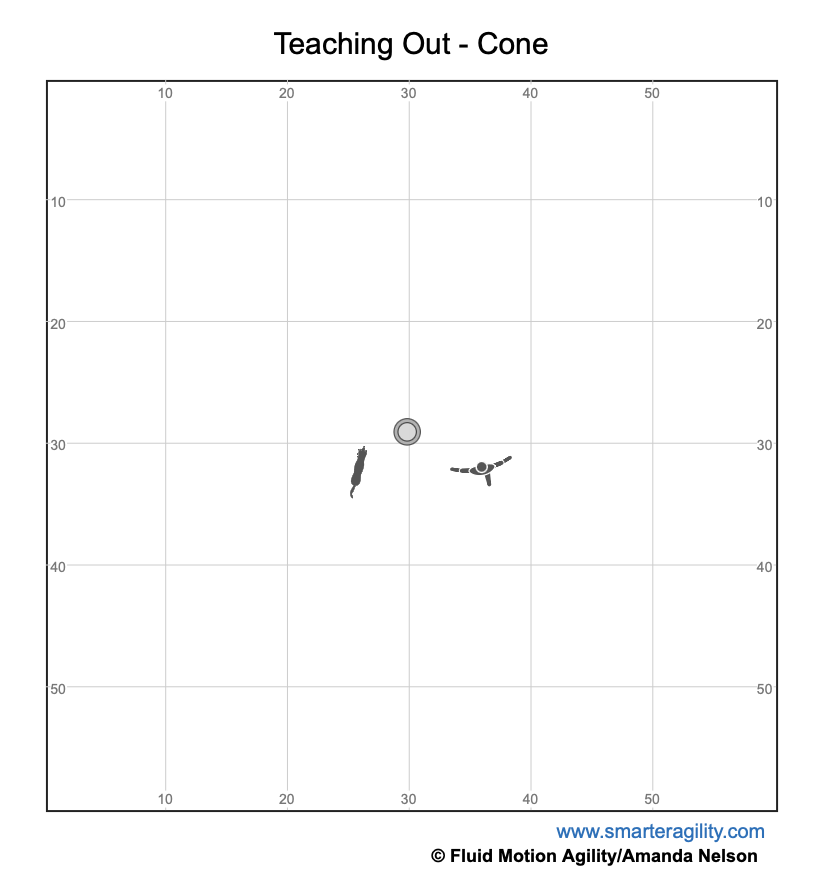
Because Out for me means for my dog to move away from me or take the obstacle furthest from me, I will start my Out foundations with a cone, and asking my dog to go to the far side of the cone.
Beginning Cone Work
The video above shows some beginning cone work with Ally. I am trying to really focus on using my lower body/feet to show her the path I want her to take around the cone.
To start, you can use either a toy or treats. I like to use a toy, as it can be easier to toss a toy to the dog to reward.
I want to take a step toward the dog with the leg closest to the dog, as I step toward the dog I will give my verbal cue “Out”. As my dog starts to move, I will toss the toy, or the treat to the far side of the cone.
Cone Work with Wall-E
I will continue working with this single cone, varying my handling positions (but always making sure my body language and verbal is clear. Do not put yourself in a handling position that would be an actual “Out”) I want to add distance to my cone to help proof my Out as well as build confidence in my dog for their Out cue.
Once I have proofed and built confidence with my dog on a single cone with their Out cue, I will start adding more cones. The videos above show working with Ally and Wall-E on multiple cones.
The above video shows examples of using multiple cones and includes a voiceover explaining what I am doing in the video clip.
Before I consider moving on to adding other pieces of equipment, I first want to make sure that my dog has full confidence in their understanding of the Out cue.
I will build my dogs confidence and clarity in the cue by continuing to proof my cone with with various handling positions as well as increasing distance.
Because I have built such a strong foundation for the Out cue, I can start bringing in other pieces of equipment and transferring my cue to those as well. I like to start with hoops, and then start incorporating the other pieces of equipment.
The biggest thing to keep in mind with teaching Out, or any directional cue, is confidence. Your first priority should be building your dogs confidence in that skill. Proof that skill with varying handling positions, and adding distance. If you take the time to really proof and build your dogs confidence at this foundation level, it will pay off down the road.
How many times do you watch your runs from a trial and pick out all the things that went wrong? Instead of all the things that went right?
I am very guilty of this and I have been trying to focus on the positive things that happened during the run instead of just focusing on everything that went wrong. And I will be the first to say, its hard!! I have to make sure and make a conscious effort to list all the good things that happened, but it has definitely helped my mental process during trials.
This doesn’t mean I ignore the things that went wrong, I will think about them, what happened, what I maybe need to go home and train, or maybe handle differently. I let those thoughts come into my mental space, and then I let them go.
I don’t want those thoughts of “all the things that went wrong” to occupy my headspace for the rest of the trial. Because if I let that happen, it will continue to loop for the rest of the day and each run could continue to loop those negative thoughts.
And what happens when those thoughts loop?
Well something happens on the next run, and “confirms” to us all the bad things, and that continues that negative loop.
And again, being honest, it is hard to let those negative thoughts go. But here is the thing I have learned. Let them occupy your mental space, sit with them for a certain amount of time, I give myself 5-10 minutes. And then move on, focus on the good things that did happen, and I mean ALL the things.
Stay at the start line? YAY!!
Hit their dogwalk contact? YES!!!!
Did that 180 sequences from 10 feet??? WOOT!!!
So for your next trial, try this, mull over those bad things in that run, give yourself a time limit, put a timer on your phone (thats what I do!) 5 or 10 minutes, and then shake them off and start going over all the good things! Take your dog for a walk, go hang out with your friends, whatever you need to do to shake off those thoughts and focus on the good stuff.








 Fluid Motion Agility